
print on demand has rewritten the playbook for how stores stock, fulfill, and grow their product lines. For new businesses, it offers a low-risk entry and highlights the print on demand benefits with minimal upfront investment. For established brands, POD can complement legacy channels by widening catalogs without tying up capital. Choosing between POD and traditional methods isn’t binary; it’s about aligning cash flow, customer expectations, and operational realities. This guide outlines the core differences and introduces practical steps to evaluate POD costs and benefits.
Seen through an alternative lens, this model is often called on-demand printing, zero-inventory merchandising, or digital manufacturing in ecommerce circles. These terms point to the same core idea: produce only what your customers order, supported by a robust fulfillment network and quick production capabilities. The emphasis shifts from stock levels to speed, consistency, and the ability to scale with rapid iteration and testing. By embracing these ideas alongside traditional stock, retailers can reserve capital while still offering a broad catalog and timely delivery. In practice, measuring lead times, quality controls, and the trade-offs between customization and speed helps determine the right blend for a given business.
1) Understanding POD vs Traditional Inventory: A Practical Framework
Print on demand (POD) and traditional inventory represent two distinct approaches to stocking, fulfilling, and growing a product line. POD lets you offer custom or themed items without upfront stock, while traditional inventory requires purchasing in bulk and storing products in a warehouse. This isn’t a binary choice; it’s about aligning your business model, cash flow, and customer expectations with production realities and fulfillment capabilities. When you frame the decision as a spectrum—POD alongside traditional inventory—you can design a blended strategy that supports experimentation and scale.
A practical framework starts with understanding your demand stability, the level of product customization you need, and how much you’re willing to invest upfront. Evaluate brand requirements, packaging standards, and the speed customers expect. Consider how each model impacts cash flow, access to new designs, and the ability to react to market changes. By mapping these factors to your catalog, you can identify which SKUs belong in POD, which belong in traditional stock, and where a hybrid approach makes sense.
2) Print On Demand Benefits: Flexibility, Testing, and Growth
The print on demand benefits are substantial for stores seeking low-risk entry and rapid catalog expansion. With POD, you avoid significant upfront investments and the risk of unsold inventory, enabling you to test new designs, themes, and product categories quickly. This flexibility supports fast iteration cycles, allowing you to refine offerings based on real customer feedback and sales data.
Beyond risk reduction, POD empowers brands to scale their catalog without tying up capital. It also facilitates limited editions and niche variations that might not justify traditional stock. When leveraging POD, it’s essential to vet providers for print fidelity, color accuracy, and consistent packaging to protect your brand reputation. A strong POD partner with solid API integrations can streamline order routing and fulfillment, further amplifying the perceived value of your store.
3) POD Costs and Unit Economics: When POD Makes Sense
POD costs form a different unit economics picture than bulk manufacturing. Per-unit printing fees, base product costs, and shipping can be higher with POD, but you avoid storage, overstock, and unsold inventory costs. For a new line or test concept, POD can be financially attractive because the barrier to entry is lower and you can gauge demand before committing capital.
To decide if POD is the right move, compare POD costs against traditional inventory costs over a defined horizon. Include storage, handling, potential markdowns, and the risk of obsolete stock. Conduct break-even analyses that incorporate hidden fees like platform integrations and returns handling. As you scale, you’ll also want to examine how economies of scale may later reduce per-unit costs with traditional inventory, balancing short-term flexibility with long-term cost efficiency.
4) Inventory Management for Retailers: A Hybrid Approach with POD
Inventory management for retailers becomes most powerful when you blend POD with traditional stock. A hybrid model keeps evergreen products in traditional inventory to ensure fast fulfillment and brand consistency, while using POD for new designs, limited runs, and seasonal items. This approach reduces risk while preserving the ability to iterate quickly and introduce fresh concepts without large upfront commitments.
A hybrid strategy also helps with category risk management. By comparing performance data across POD and traditional channels, you can reallocate SKUs to the model that delivers better margins, faster turns, or stronger brand alignment. Over time, data-driven decisions allow you to optimize inventory mix, improve cash flow, and maintain a resilient fulfillment network that scales with demand.
5) POD Fulfillment Process: Speed, Quality, and Reliability
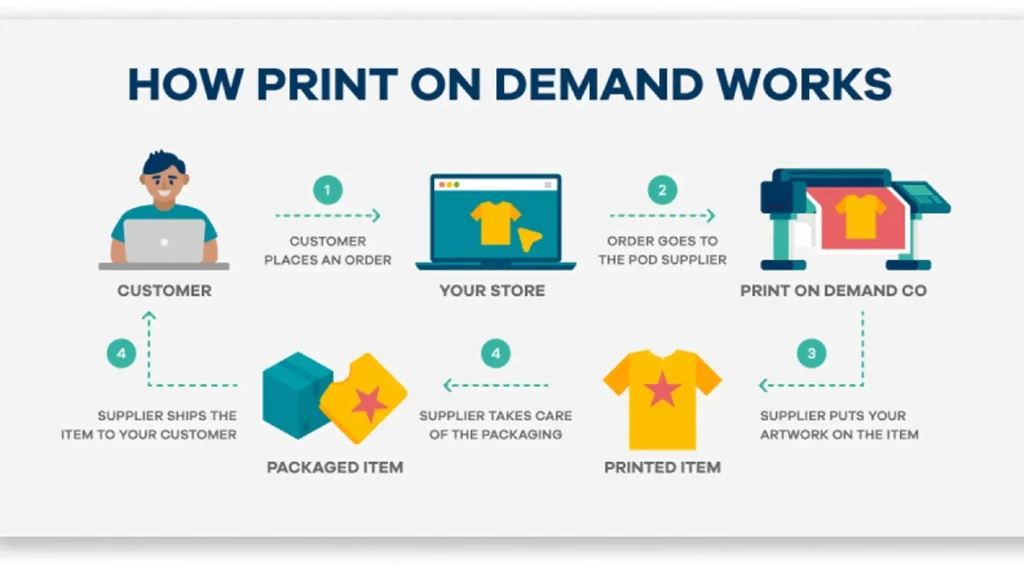
The POD fulfillment process centers on the speed and quality of production, printing, and shipping. Fulfillment timelines can vary by provider, product type, and geography, so mapping your typical order flow helps you anticipate bottlenecks and set accurate customer expectations. Ship-from-origin hubs and regional networks are common features that can shorten transit times and improve delivery estimates.
Quality control remains critical in POD. Test samples to verify print fidelity, color accuracy, material durability, and packaging alignment with your brand. Since packaging and unboxing experiences may be less controllable than with traditional stock, choose POD partners who offer reliable packaging options and clear return policies. A transparent POD fulfillment process builds trust and reduces post-purchase friction for customers.
6) Choosing Between Models: A Practical Framework to Balance Traditional Inventory and POD
There isn’t a one-size-fits-all answer to traditional inventory versus POD. Start with a practical framework that assesses demand stability, customization needs, cash flow, and speed expectations. If demand is steady and you want maximum control, traditional inventory may dominate; if demand is volatile or you want to test dozens of designs, POD can be a powerful complement. The framework should also consider brand experience and scalability, helping you decide where to allocate capital and effort.
A rigorous evaluation includes piloting both models, running break-even analyses, and measuring key metrics such as inventory turnover, order fulfillment speed, and customer satisfaction related to print quality and delivery. By selecting a blended approach and continuously testing, retailers can preserve the speed and branding advantages of traditional stock while leveraging POD for flexibility and rapid iteration, ultimately delivering a smoother, more resilient customer experience.
Frequently Asked Questions
What are the print on demand benefits for new stores?
Print on demand benefits include zero upfront inventory, lower financial risk, and the ability to rapidly test and expand your product catalog. With POD, you can launch designs quickly and scale only after you’ve confirmed demand, while avoiding costs tied to holding stock. Partner with a reliable POD provider to ensure consistent print quality and a smooth customer experience.
How does traditional inventory compare to POD in everyday retail operations?
Traditional inventory offers greater control over branding, packaging, and potentially faster fulfillment for stocked items, but it requires upfront capital and storage space. Print on demand minimizes risk and storage needs but relies on a third-party for print quality and turnaround. In practice, many retailers blend both models to balance control, speed, and risk.
How do POD costs affect profitability and unit economics?
POD costs are typically higher per unit than bulk manufacturing, but you save on storage, overstock, and write-offs. To assess profitability, run a break-even analysis that includes printing fees, shipping, and platform costs, then compare with traditional inventory costs like manufacturing, warehousing, and handling. Scale decisions should weigh long-term savings against per-unit expenses.
How can inventory management for retailers optimize a hybrid POD approach?
Inventory management for retailers benefits from a hybrid approach: keep evergreen, high-demand items in traditional stock for fast fulfillment and branding control, while using POD for new designs or limited runs. Use data to rebalance SKUs between models, monitor turnover, and adjust budgets so the catalog stays fresh without risking overstock.
What is the POD fulfillment process from order to customer delivery?
In a typical POD fulfillment process, the customer order triggers printing, quality checks, and packaging by the POD provider, followed by shipping to the customer. Lead times vary by product and geography, so test samples and map end-to-end timelines to set accurate expectations and build buffers into your planning.
What steps should I take to test demand and decide between POD and traditional inventory?
Start with a small POD pilot to gauge demand, then run a break-even analysis comparing POD costs to traditional costs. Order samples to assess print fidelity and packaging, test in limited markets, and track metrics such as fulfillment speed, quality, return rate, and customer satisfaction. Use the results to guide a blended strategy that leverages POD advantages while preserving the strength of traditional stock.
| Aspect | POD (Print on Demand) | Traditional Inventory |
|---|---|---|
| Definition / Concept | Prints products on order; no upfront stock. A POD provider prints, packs, and ships when a customer orders. | Bulk purchases kept in stock; orders fulfilled from inventory in a warehouse or fulfillment center. |
| Upfront costs & risk | Low upfront investment and reduced risk of unsold stock; higher per-unit costs. | Higher upfront investment and carrying costs, but lower per-unit costs at scale (economies of scale). |
| Branding & packaging control | Branding and packaging options exist but can be limited by the POD provider; packaging control may be lighter. | Greater control over branding, packaging, and unboxing experience. |
| Lead times & fulfillment speed | Fulfillment times vary by provider and region; potential delays if production queues are long. | Often faster fulfillment for stocked SKUs when a solid warehouse network is in place. |
| Catalog testing & customization | Strong for customization, rapid iteration, and low-risk testing of new designs. | Better for standardized items; slower to test new designs and variations. |
| Costs per unit vs economies of scale | Higher per-unit costs, with no storage or overstock costs. | Lower per-unit costs at higher volumes, but storage and handling costs apply. |
| Inventory strategy | Often used for new designs, limited runs, or non-core items; commonly paired in a hybrid model. | Core items kept in traditional stock for fast fulfillment and branding control. |
| Decision framework | Consider demand stability, customization needs, cash flow, brand experience, and speed expectations. | Consider similar factors for core items; e.g., demand, customization, cash flow, branding, and speed. |
| Practical evaluation steps | Break-even analysis, order samples, test lead times, run small pilots, monitor fulfillment & quality metrics. | Same evaluation approach applies to traditional suppliers plus stock-risk analysis and turnover metrics. |
| Provider selection tips | Choose a partner with network reach, clear production timelines, quality control, strong integrations, transparent pricing, and clear returns. | Seek reliable suppliers with consistent quality, branding options, inventory reliability, and favorable terms. |
Summary
Conclusion: Print on demand offers a balanced approach to scaling an ecommerce store, enabling rapid catalog expansion with low upfront risk while traditional inventory provides branding control and faster fulfillment for stocked lines. By blending these models, retailers can optimize cash flow, reduce overstock risk, and deliver a consistent customer experience. Start with a POD pilot for non-core items while maintaining traditional stock for best-sellers, then use real-world data to guide longer-term strategy and the right mix for your brand.