
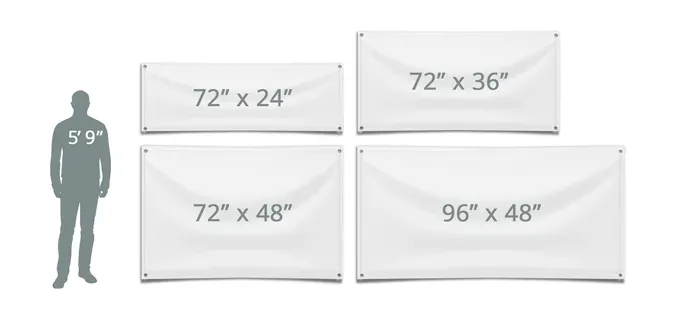
Custom banner sizes unlock the full potential of your visual message, letting you tailor displays to any space. From portable roll up banner sizes to expansive wall graphics, choosing the right dimensions drives readability, brand consistency, and engagement for measurable impact. A solid banner size guide helps you balance space, distance, and design, ensuring your core message remains clear at a glance across channels and formats. When planning, consider trade show banner dimensions and printing banner dimensions to align production and venue constraints. Mastering Custom banner sizes early in the process also makes it easier to plan around custom banner dimensions, typography, and branding across venues.
Viewed through a broader lens, banner sizing becomes about footprint, layout, and display scale rather than a single measurement. Using alternative terms such as banner dimensions, signage measurements, and display size helps teams align with printers, venues, and event planners. These related concepts create a semantic map that guides space planning, readability, and branding across booths, storefronts, and exhibition walls.
Understanding Custom banner sizes: Principles, planning, and impact
Custom banner sizes hinge on width, height, aspect ratio, and viewing distance. When you plan Custom banner sizes, consider your venue and how the message scales from near to far. Width and height define the overall footprint, while the aspect ratio ensures artwork scales cleanly as you resize. For print projects, aim for 300 DPI at the final size, though larger formats may tolerate slightly lower resolution if the viewing distance is greater. Bleed and safe areas matter too, helping ensure color goes to the edge and critical content stays within trim during production.
Bleed beyond the trim edge guarantees color continuity, and safe areas keep important text and logos away from the edge so nothing gets cropped. As you design around Custom banner sizes, these conventions align with standard printing practices and the goal of readability at distance. Balancing practicality with branding, you’ll also want to reference related concepts such as the custom banner dimensions and how they interact with a broader banner size strategy.
Roll Up Banner Sizes: Choosing the Right Width for Quick Deployments
Roll up banner sizes provide a portable, quick-setup option for events, lobbies, and studios. The most common roll up banner sizes are in the 33-inch to 36-inch width range with heights around 78 to 80 inches, though some versions extend taller for special corners or ceilings. When evaluating roll up banner sizes, consider viewing distance: closer distances demand bolder typography and higher contrast to maintain legibility.
For tight spaces, keep height proportional to width to preserve readability at a standard eye level. For longer walls or curved surfaces, you may deploy multiple banners or a larger backdrop to create a continuous visual narrative. Understanding roll up banner sizes helps you select a unit that fits your space while preserving branding consistency across your setup.
Custom Banner Dimensions: Measuring Your Space for Impact
For unique rooms, storefronts, or trade show booths, measuring your space is the first step toward effective Custom banner dimensions. Identify the primary viewing distance and the wall or display area where the banner will reside, then map out obstructions such as doors, windows, lighting fixtures, or furniture that could affect readability. Practical steps include planning for orientation, whether portrait or landscape, to optimize how your message is perceived.
Here are actionable steps to determine your custom banner dimensions: measure the available width and height with a little breathing room, confirm the maximum width the mounting hardware can support, and think about how distance affects typography size. Plan for printing margins and bleed, and ensure your digital artwork includes safe zones so the final piece isn’t cropped or misaligned.
The Banner Size Guide: Practical Reference for Indoor and Outdoor Displays
A reliable banner size guide helps you pick dimensions that fit both indoor and outdoor contexts. Common indoor references include 33 by 80 inches and 36 by 80 inches, while larger storefront backdrops or trade show displays may use formats like 8 feet by 3 feet or wider, depending on space. By consulting a banner size guide, you can select sizes that balance legibility, portability, and impact.
Distance, lighting, and branding requirements should guide your choices. A consistent size guide ensures you meet production templates and maintain visual cohesion across multiple banners. Use the banner size guide as a framework when ordering prints to ensure alignment with file templates, cropping rules, and trim tolerances.
Trade Show Banner Dimensions: Planning a Cohesive Booth
Trade show banner dimensions require coordinating different banner types to create a cohesive booth presence. A common approach is to feature one prominent wide banner at the center and flank it with smaller roll up banners on either side to support key messages and branding. This setup leverages trade show banner dimensions to maximize visibility while maintaining a clear information hierarchy.
Since venue layouts vary, it helps to develop a flexible layout plan that specifies the sizes and placements of each banner. A practical approach is to map your booth footprint and simulate sightlines from typical attendee distances. Rely on a banner size guide to ensure consistency in tone, typography scaling, and color across all banners in your trade show display.
Printing Banner Dimensions: Ensuring Clarity, Bleed, and Materials for Quality
Printing banner dimensions demand attention to resolution, bleed, safe zones, and file formats. Aim for 300 DPI at the final print size to keep text crisp and images sharp, and prefer vector-based files (AI, EPS) or PDFs with embedded fonts for scalable artwork. Understanding printing banner dimensions helps avoid pixelation or cropping when banners are viewed at distance.
Material choice and outdoor versus indoor use influence readability and durability. Outdoor banners require weather-resistant substrates and appropriate coatings, while indoor banners can prioritize color vibrancy and weight. Before finalizing printing banner dimensions, confirm with your print supplier about material specs, mounting methods, and any wind or glare considerations to ensure a long-lasting, high-impact display.
Frequently Asked Questions
What are Custom banner sizes and why do they matter for my space?
Custom banner sizes describe width and height combinations tailored to your venue. They affect readability, branding, and fit by balancing viewing distance, aspect ratio, and available space. When planning Custom banner sizes, consider roll up banner sizes as a compact option and consult a banner size guide to select practical dimensions, while planning for bleed and safe zones to avoid trimming issues.
How do roll up banner sizes fit into Custom banner sizes for events?
Roll up banner sizes are a common starting point within Custom banner sizes. Typical widths range from 33 to 36 inches with heights around 78 to 80 inches, with taller options for corners. Choose size based on viewing distance and space; for longer walls you may use multiple banners to maintain branding and continuity.
How can I determine custom banner dimensions for a storefront or trade show booth?
To determine custom banner dimensions, start by measuring the available width and height, assess the viewing distance, and note any obstructions. Decide on orientation (portrait or landscape) and confirm hardware limits for the maximum width. Include bleed and safe zones in your plan, then translate these measurements into practical Custom banner sizes.
What is a banner size guide and how does it relate to Custom banner sizes?
A banner size guide is a resource listing common dimensions and recommended uses, helping you pick appropriate Custom banner sizes for different venues. It covers roll up banner sizes, larger backdrops, and indoor vs outdoor formats, plus practical tips on aspect ratios, readability, and production considerations.
What should I know about trade show banner dimensions when planning Custom banner sizes?
Trade show booth plans often mix banners of different sizes to maximize impact. Use a central wide banner and add roll up banners on the sides to support messaging, while maintaining consistent branding. Rely on a banner size guide to keep proportions aligned with your booth footprint and viewing distances within the realm of Custom banner sizes.
How do printing banner dimensions influence final output for Custom banner sizes?
Printing banner dimensions affect resolution and image sharpness. Use 300 DPI at the final print size, plan for bleed, and keep critical content in safe areas to avoid cropping. Export PDFs with embedded fonts or vector files (AI, EPS) for best results, and confirm printing banner dimensions with your supplier when designing Custom banner sizes.
| Aspect | Key Point | Notes |
|---|---|---|
| Definition | Custom banner sizes are dimensions tailored to fit a specific space, balancing readability and impact; they cover roll up banner sizes, trade show banner dimensions, and larger backdrops. | In practice, space, distance, and branding influence width and height choices. |
| Core concepts | Width, height, aspect ratio, and resolution (300 DPI standard; higher DPI for close viewing). | Bleed and safe areas protect edges during trimming. |
| Standard vs custom | Standard sizes align with templates and produce quickly; custom sizes optimize venue fit but may incur extra setup time and cost. | Consider venue shape and brand consistency. |
| Roll up banner sizes | Most common roll up widths are 33–36 inches with heights around 78–80 inches. | Taller options exist for corners; adjust for viewing distance. |
| Custom banner dimensions: measurement | Measure space, determine viewing distance, check obstructions, and plan orientation and margins. | Ensure hardware max width and bleed/safe zones. |
| Common indoor sizes | Typical options include 33×80 and 36×80 inches; larger backdrops around 8 feet by 3 feet or wider, depending on booth. | Size should fit space and maintain legibility. |
| Design and readability | Prioritize clear typography, high contrast, concise messaging, and proper hierarchy. | Use high-res imagery and ensure logos stay within safe zones. |
| Outdoor considerations | Outdoor banners require durable materials and wind considerations; choose reinforced vinyl or fabric with laminate. | Confirm material specs with printer; wind loads may constrain width/height. |
| Trade show banner dimensions | Plan booth with multiple banners of varying sizes to create a cohesive display. | Use a central wide banner and supporting roll ups; align with venue guidelines. |
| Practical workflow | Step-by-step process from space definition to artwork delivery. | Steps include measure space, determine distance, select banner type, choose dimensions, prepare artwork, review proof. |
| Common pitfalls | Avoid overcrowded text, low contrast, edge cropping, and inconsistent branding. | Keep branding consistent across all banners. |
Summary
Custom banner sizes are a foundational consideration for any space, from compact roll up banners to expansive backdrops. By understanding how width, height, aspect ratio, and DPI influence readability and impact, you can tailor banners to your venue and audience distance. Start with measuring the space, consider orientation and viewing distance, and then choose between roll up banner sizes for portability or custom banner dimensions for a perfect fit. Design with strong typography, high contrast, and clear hierarchy, and select materials appropriate for indoor or outdoor use. Plan a cohesive trade show display by combining banners of different sizes, and follow a practical workflow to ensure bleed, safe zones, and production accuracy. With careful sizing decisions that align with your space and brand, your banner communicates your message clearly and consistently across every display.